I started with a simple goal: get Qwen running on my own machine so I could try a local language model. By the end of the project, the same Ubuntu server was running a browser-based chat interface and a separate video-generation app. An AWS EC2 instance gave both services a public HTTPS address, while the model workloads stayed at home.
Qwen, Ollama, and Open WebUI
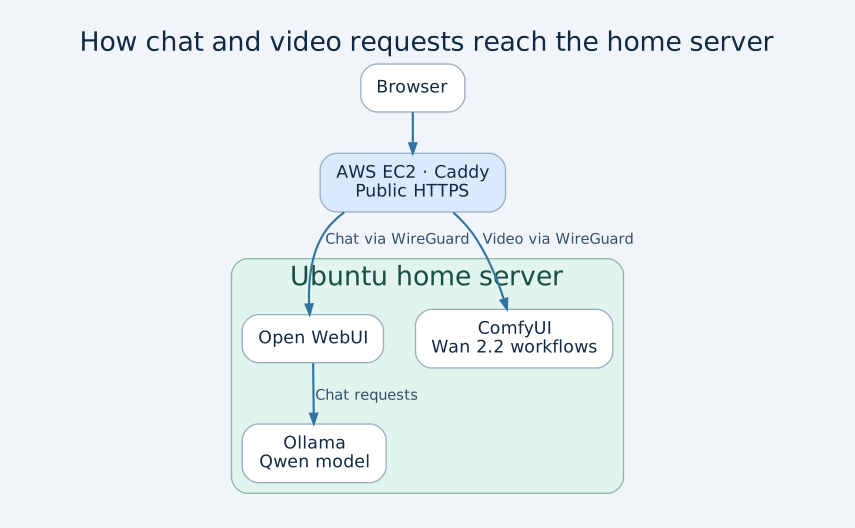
Ollama runs the Qwen model. Open WebUI gives me a chat interface in the browser and sends requests to Ollama. Having those pieces separate was helpful for troubleshooting. I could check whether the model responded locally before looking at the web interface or the public connection.
I kept Open WebUI on its own hostname, ai.doubletrees.com. That gave me a stable address for chat while I added other services to the same server.
Adding video generation
I added ComfyUI as a separate application for experimenting with Wan 2.2 video workflows. In ComfyUI, the workflow is a graph. The model, prompt, sampling, and output are visible as connected steps, so I can change one part of a workflow and see what happens.
Chat and video generation are separate workloads. They share the Ubuntu host, but each app has its own upstream port and hostname. ComfyUI is at video.doubletrees.com.
Connecting the home server to AWS
Caddy runs on EC2 and handles public HTTPS. A WireGuard tunnel connects EC2 to the home server, so Caddy reaches each app at the home server’s tunnel address. A browser request goes to Caddy first, then across WireGuard to the requested app. Inference runs on the Ubuntu machine.
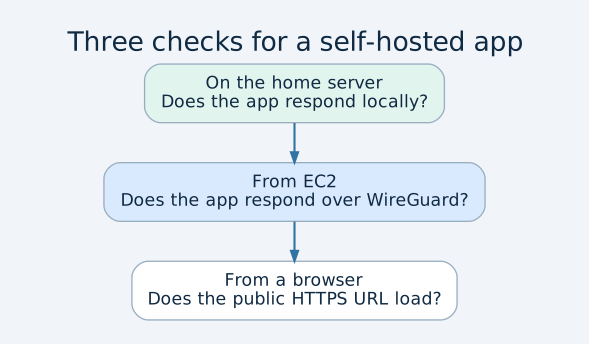
One useful test was requesting ComfyUI’s /system_stats endpoint from EC2 over the tunnel. It returned HTTP 200. That confirmed the upstream was reachable from the machine running Caddy and gave me a concrete way to test the network path independently of public DNS or HTTPS.
What I’d repeat
I’d bring up each app locally, test it over WireGuard from EC2, and then test the public hostname. Each step narrows down where to look when something fails. A browser error at the public address can come from the proxy or TLS even when the model and the app are both running fine.
I reused that same network path when I added this Hugo blog. The next post walks through how I brought up the new domain and debugged its first HTTPS failure.